Olympic Games for Kids

Olympic Games for Kids

Olympic Games for Kids
In first grade, students are developing their graphing skills. They’re learning how to record, organize, and show data. Of course, all of that can get a little dry. To spice it up, form your own Olympics committee and host The Olympic Games for Kids, right in your own backyard! Appoint your child statistician, and collecting data and showing the results on a graph will be serious fun. Let the games begin!

What You Need:
Ball suitable for kicking
Yard or play area
Measuring tool (yardstick, tape measure)
String or rope for a starting line
Paper
Ruler
Markers or crayons (at least 5 different colors)
Pencil
What You Do:
Set up a “Kick Ball” venue. Decide where to position the “kicking lane” and use a length of string to mark the starting line. Give each child five opportunities to kick the ball. After each kick, measure the distance and record it.

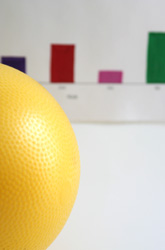
Set up a bar graph. This will help your child show and compare her results. On the x-axis (the horizontal line) label the number of each kick, using ordinal numbers (1st, 2nd, etc.) On the y-axis (the vertical line) show the number of feet. Begin with 0 feet and then continue the numbers until you reach the number that is a few feet farther than your child’s farthest kick. You can show the numbers in increments of 2, 5, or 10. To create a grid, draw a horizontal line to the right of each number showing feet. Draw intersecting vertical lines to the right of each labeled kick (1st, 2nd, etc.).

Record results. Show your child how to make bars on the graph showing the distance for each kick. Let your child color the boxes of each bar.

Talk about the meaning of the graph. Compare the results with your child. Ask questions like, “Which kick shows the greatest distance? How do we know it from the graph?” (It shows the longest row). Ask which row shows the shortest kick, and how we can see that on a graph as well. Finally, show your child your preliminary recording of his kicking distances and and ask him to compare this with the bar graph you’ve made. Ask him which method of showing data is easier for him to understand. After you’re discussion is finished, be sure to congratulate your child on his success in Backyard Olympics!

Once your child gets the hang of graphs, you’re ready to add more events to your Olympic games! Long jumps work well; so does swinging on monkey bars (How many bars can you reach in thirty seconds? One minute?); or jumping rope. Whatever you choose, keep a record and talk it over. You’re helping your child build crucial intellectual skills while using the power of his entire body.
Play Four Square!

Play Four Square!

Play Four Square!
What kid doesn’t enjoy bouncing a ball around? Similar to the playground game Four Square, this group game helps your child improve his hand-eye coordination and boosts important social skills like group cooperation, teamwork, group problem solving, and compromise. You can play Bounce in the Square on any flat, paved surface with just a bit of sidewalk chalk, a bouncy ball, and at least 4 enthusiastic players. Preparation takes less than two minutes, and the fun lasts all day!

What You Need:
4 or more players
Playground-style rubber ball
Sidewalk chalk
Flat paved surface at least 8′ X 8′ large (like a driveway or patio)
What You Do:
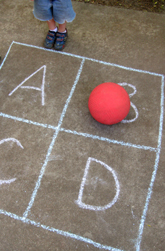
To create your playing court, draw a 2 x 2 square grid measuring 8′ x 8′ on the paved surface with the sidewalk chalk. Draw a large capital “A” in the upper left square, a capital “B” in the upper right square, a capital “C” in the lower right square, and a capital “D” in the lower left square.
The player in square A gets the ball first. Each of the squares is ranked, with A being the highest and D being the lowest. The goal of the game is to get to square A and remain there for as long as possible.
To begin the game, player A bounces the ball in his square, then serves it to a player in another square by either hitting it lightly with the palm of his hand or gently tossing it.
Each time the ball bounces in a player’s square, he must hit or catch and toss the ball into another square, making sure the ball bounces only once in his square. If a player catches the ball before it falls in his square, he must bounce it in his square before returning it.
Have the players continue hitting and tossing the ball back and forth until one of the players fails to return the ball to an opponent. That player then moves to square D and the players who were behind him move up one square. For example, if player B fails to return the ball, he moves to square D and players C and D move to squares B and C, respectively.
If more than 4 children are playing, have those who don’t have a square form a line next to the court. When a player fails to return a ball, he moves to the back of the line and the player at the start of the line moves to square D.
To make the game more challenging, incorporate special calls into the play. A special call is a spontaneous action prompt given by player A that all players must follow. Player A must have the ball before making a special call. If a player fails to execute a special call, he moves to square D or to the back of the line. Examples of special calls:
Corners: All players run to the farthest corner of their squares.
Bus Stop: All players run to cover their letter with one foot.
Candlesticks: Player A starts by throwing the ball into the air, claps once, then catches the ball and passes it to player B. Player B then does the same, except he must clap twice instead of once! The action continues around the squares, each subsequent player adding an extra clap.
Taxi: All players run to cover their letter with two feet.
Titanic: All players kneel on one knee, mimicking the motion of a sinking ship.

Watermelon Seed Spitting Contest

Watermelon Seed Spitting Contest

Watermelon Seed Spitting Contest
Turn any sunny summer day into a fun and special occasion by having a watermelon seed-spitting contest! Fresh watermelon can turn a whole afternoon into fun and games for the entire family.

What You Need:
Watermelon
White paper
Markers
Large knife
Measuring tape
Chalk

What You Do:
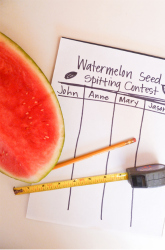
1 Invite your child to gather the ingredients for the seed-spitting contest. He can get started creating a scorecard to keep track of each participant’s seed-spitting distance.
2 Help your child cut the watermelon using a large knife into several slices, making sure each one has lots and lots of seeds.
3 Remember, watermelon seeds can be a choking hazard, so make sure those participating in the seed-spitting contest are over three years of age!
4 Now your child can find the perfect spot for the seed-spitting contest – a driveway works wonderfully. He can use a piece of chalk to mark where the player stands.
5 Each person can take a turn standing on the line while eating a slice of watermelon, and spitting the seeds. Your child can use the measuring tape to measure and mark the distances. Not only is he having fun participating in a game, but learning more about measurement.
Once everyone has had a turn, your child can announce the winner – and offer a special winning treat!

Run Around the Numbers

Run Around the Numbers

Run Around the Numbers
Get ready to play with numbers outdoors! Your child will actively build a strong math foundation while playing outdoors. This game is also a great way to help kids learn how to effectively follow directions. Grab some chalk, do some preliminary stretches and start memorizing those numbers.

What You Need:
Paved outdoor area
Colored sidewalk chalk
What You Do:
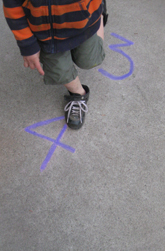
Ask the players to spread out and assign them a number to write in chalk on the pavement. Make sure they make the numbers large enough so they can be seen from a distance and far enough away from one another that they don’t collide while running to their numbers!
Explain that you will shout out a number randomly. When the players hear it, they need to dash to the number and stand on top of it.
Tell them to stand on that number until you call out the next number.
If players get to the number first, have them cheer on their friends until they find their own numbers.
After the players get comfortable with the game, switch it up a bit and have one of the kids call out the numbers. Or, trade out the numbers for colors or shapes.

Jokes for Maths

Jokes for Maths

Jokes for kids: Maths
Enjoy numbers a little more when the kids are reading these giggle-inducing problems to solve. One plus one equals two is all you need to get a laugh from these maths jokes for kids.
Number of players:
2+
Activity:
Q. Why was the maths book sad?
A. Because it had too many problems.

Q. What’s the king of the pencil case?
A. The ruler.

Q. What US state has the most maths teachers?
A. Mathachussets.

Q. Heard about the mathematical plant?
A. It has square roots.

Q. Which tables do you not have to learn?
A. Dinner tables.

Q. What tool do you use in maths?
A. Multi-plyers.

Q. Why was 6 afraid of 7?
A. Because 7 8 9!

Q. What do you get if you cross a maths teacher and a clock?
A. Arithma-ticks!

Q. What is 67 + 35 + 99 + 136 + 84?
A. A headache.

Q.How do you make one vanish?
A. Add a ‘g’ to the beginning and it’s gone!

Jokes for Fruit

Jokes for Fruit

Jokes for kids: Fruit
Peel away the layers of laughter with these very ‘ap-peel-ing’ fruit jokes for kids. Every child will look at their fruit in a different way after sharing these jokes for kids around with their friends.
Number of players:
2+
Activity:
Q. How do you make a strawberry shake?
A. Put it in the freezer.

Q. What is a vampire’s favourite fruit?
A. A neck-tarine!

Q. How do you fix a broken tomato?
A. Tomato paste!

Q. What school subject is the fruitiest?
A. History – because it is full of dates!

Q. What fruit teases you a lot?
A. A Ba na..na..na..na..na!

Q. What kind of apple has a short temper?
A. A crab apple.

Q. What happens to grapes when you step on them?
A. They wine!

Q. How do you fix a cracked pumpkin?
A. With a pumpkin patch!

Q. Why did the banana go to the doctor?
A. Because it wasn’t peeling well.

Q. Why was the tomato blushing?
A. Because it saw the salad dressing.

Jokes for Elephants

Jokes for Elephants

Jokes for kids: Elephants
Ever have trouble remembering jokes? Pity you haven’t got the memory of an elephant, they don’t mind poking fun at themselves. Here’s 10 great jokes I’m sure they’ve got in their memory bank!
Number of players:
2+
Activity:
Q. How do you know if there’s an elephant in your fridge?
A. There are footprints in the butter.

Q. Why doesn’t the elephant use a computer?
A. Because it is afraid of the mouse!

Q. What time is it when an elephant sits on the fence?
A. Time to fix the fence!

Q. What’s grey and goes round and round?
A. An elephant in a washing machine!

Q. What’s big and grey and has 16 wheels?
A. An elephant on roller skates!

Q. Why do elephants need trunks?
A. Because they don’t have glove compartments!

Q. How does an elephant put his trunk in a crocodile’s mouth?
A. VERY carefully!

Q. What did the banana say to the elephant?
A. Nothing. Bananas can’t talk silly!

Q. What do elephants do in the evenings?
A. Watch elevision!

Q. What’s grey with red spots?
A. An elephant with the measles!

Jokes for Dogs

Jokes for Dogs

Jokes for kids: Dogs
Dog-gone are the days of little laughter in the house when the kids get wind of these great kids’ dog jokes. From mutt ado about nothing to poochy perfection, we have it covered with these 10 top jokes for kids!
Number of players:
2+
Activity:
Q. What happened when the dog went to the flea circus?
A. He stole the show!

Q. Why was the dog sweating so much?
A. He was a hotdog!

Q. What kind of dog likes baths?
A. A Shampoodle

Q. What dog keeps the best time?
A. A watch dog!

Q. What did one flea say to the other?
A. Should we walk or take a dog?

Q. What do you get if you cross a cocker spaniel, a poodle and a rooster?
A. Cockerpoodledoo!

Q. Why do dogs run in circles?
A. Because it’s hard to run in squares!

Q. What do you get if you cross a Beatle and an Australian dog?
A. Dingo Starr!

Q. What do you call a great dog detective?
A. Sherlock Bones!

Q. Why don’t dogs make good dancers?
A. Because they have two left feet!

Jokes for Doctor

Jokes for Doctor

Jokes for kids: Doctor, Doctor
Some ‘Doctor, Doctor’ jokes might make you a little feverish but these kids jokes will have a laughter-inducing effect. So cure that fever and print off these medicinal miracles for your kids!
Number of players:
2+
Activity:
Doctor, Doctor, I swallowed a bone.
Are you choking?
No, I really did!

Doctor, Doctor, I’ve got wind! Can you give me something?
Yes – here’s a kite!

Doctor, Doctor, everyone keeps throwing me in the garbage.
Don’t talk rubbish!

Doctor, Doctor, I feel like a pack of cards.
I’ll deal with you later.

Doctor, Doctor, will this ointment clear up my spots?
I never make rash promises!

Doctor, Doctor, I keep seeing an insect spinning around.
Don’t worry, it’s just a bug that’s going around!

Doctor, Doctor, everyone thinks I’m a liar.
I can’t believe that!

Doctor, Doctor, how can I cure my sleep walking?
Sprinkle tin-tacks on your bedroom floor!

Doctor, Doctor, my baby’s swallowed a bullet.
Well, don’t point him at anyone until I get there!
Doctor, Doctor, I keep thinking I’m a vampire.
Necks, please!

Jokes for Christmas

Jokes for Christmas

Jokes for kids: Christmas
Bring some laughter to the table this year. These hilarious Christmas jokes will knock the Christmas stockings right off your feet! You’ll be sure to have a sack full of giggles.


Number of players:
2+
Activity:
Q. What did the cow say on Christmas morning?
A. Mooooey Christmas!

Q. What never eats at Christmas time?
A. The turkey – it’s usually STUFFED!

Q. Why couldn’t the Christmas tree stand up?
A. A Christmas tree does not have legs like we do!

Q. What is the most special part of your body at Christmas?
A. MistleTOE!

Q. What goes “oh, oh, oh”?
A. Santa walking backwards!

Q. What do monkeys sing at Christmas?
A. Jungle bells, jungle bells!

Q. What does a cat on the beach have in common with Christmas?
A. Sandy claws!

Q. What is green, white, and red all over?
A. A sunburnt elf!

Q. What rains at the north pole?
A. Reindeer!

Q. Which of Santas reindeer has bad manners?
A. Rude-olph!