Play Drop Catch

Play Drop Catch

Play Drop Catch
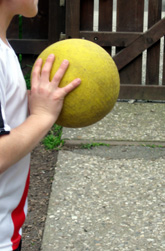
Develop your child’s hand-eye coordination in an engaging way by challenging her to a game of Drop Catch. You can play this game with just a parent and child, or gather a couple of antsy kids, form a circle, and go at it as a group. Not only is this game rambunctious fun, but it works gross motor skills and big muscles– all too rare with today’s kids.

What You Need:
Ball
2 kids
What You Do:
Have the players stand at a distance from each other. They can be close together or far apart, whichever is most comfortable for them.
Instruct the players to throw the ball back and forth between them.
If a player drops the ball, he has to pay a penalty. On the first drop, he must go down on one knee and throw the ball back. If he catches the ball on the next throw, he can stand up again. If not, he goes down on both knees. Here are all the penalties according to number of drops:
1st drop: go down on one knee

2nd drop: go down on both knees

3rd drop: go down on both knees, one hand on the ground

4th drop: go down on both knees, one hand on the ground, one eye closed

5th drop: go down on both knees, one hand on the ground, both eyes closed

6th drop: you’re out

For each ball caught, a player can only subtract one penalty level. For example, if a player is at the 4th penalty level, with both knees on the ground, one hand on the ground, and one eye closed, and catches the ball, he can move up to the 3rd penalty level. If he catches the ball again, he moves to the 2nd penalty level, and so on.
Encourage the players to keep tossing the ball until one person is out.
Olympic Games for Kids

Olympic Games for Kids

Olympic Games for Kids
In first grade, students are developing their graphing skills. They’re learning how to record, organize, and show data. Of course, all of that can get a little dry. To spice it up, form your own Olympics committee and host The Olympic Games for Kids, right in your own backyard! Appoint your child statistician, and collecting data and showing the results on a graph will be serious fun. Let the games begin!

What You Need:
Ball suitable for kicking
Yard or play area
Measuring tool (yardstick, tape measure)
String or rope for a starting line
Paper
Ruler
Markers or crayons (at least 5 different colors)
Pencil
What You Do:
Set up a “Kick Ball” venue. Decide where to position the “kicking lane” and use a length of string to mark the starting line. Give each child five opportunities to kick the ball. After each kick, measure the distance and record it.

Set up a bar graph. This will help your child show and compare her results. On the x-axis (the horizontal line) label the number of each kick, using ordinal numbers (1st, 2nd, etc.) On the y-axis (the vertical line) show the number of feet. Begin with 0 feet and then continue the numbers until you reach the number that is a few feet farther than your child’s farthest kick. You can show the numbers in increments of 2, 5, or 10. To create a grid, draw a horizontal line to the right of each number showing feet. Draw intersecting vertical lines to the right of each labeled kick (1st, 2nd, etc.).

Record results. Show your child how to make bars on the graph showing the distance for each kick. Let your child color the boxes of each bar.

Talk about the meaning of the graph. Compare the results with your child. Ask questions like, “Which kick shows the greatest distance? How do we know it from the graph?” (It shows the longest row). Ask which row shows the shortest kick, and how we can see that on a graph as well. Finally, show your child your preliminary recording of his kicking distances and and ask him to compare this with the bar graph you’ve made. Ask him which method of showing data is easier for him to understand. After you’re discussion is finished, be sure to congratulate your child on his success in Backyard Olympics!

Once your child gets the hang of graphs, you’re ready to add more events to your Olympic games! Long jumps work well; so does swinging on monkey bars (How many bars can you reach in thirty seconds? One minute?); or jumping rope. Whatever you choose, keep a record and talk it over. You’re helping your child build crucial intellectual skills while using the power of his entire body.

Play Four Square!

Play Four Square!

Play Four Square!
What kid doesn’t enjoy bouncing a ball around? Similar to the playground game Four Square, this group game helps your child improve his hand-eye coordination and boosts important social skills like group cooperation, teamwork, group problem solving, and compromise. You can play Bounce in the Square on any flat, paved surface with just a bit of sidewalk chalk, a bouncy ball, and at least 4 enthusiastic players. Preparation takes less than two minutes, and the fun lasts all day!

What You Need:
4 or more players
Playground-style rubber ball
Sidewalk chalk
Flat paved surface at least 8′ X 8′ large (like a driveway or patio)
What You Do:
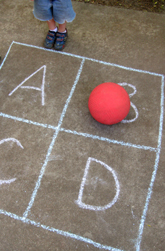
To create your playing court, draw a 2 x 2 square grid measuring 8′ x 8′ on the paved surface with the sidewalk chalk. Draw a large capital “A” in the upper left square, a capital “B” in the upper right square, a capital “C” in the lower right square, and a capital “D” in the lower left square.
The player in square A gets the ball first. Each of the squares is ranked, with A being the highest and D being the lowest. The goal of the game is to get to square A and remain there for as long as possible.
To begin the game, player A bounces the ball in his square, then serves it to a player in another square by either hitting it lightly with the palm of his hand or gently tossing it.
Each time the ball bounces in a player’s square, he must hit or catch and toss the ball into another square, making sure the ball bounces only once in his square. If a player catches the ball before it falls in his square, he must bounce it in his square before returning it.
Have the players continue hitting and tossing the ball back and forth until one of the players fails to return the ball to an opponent. That player then moves to square D and the players who were behind him move up one square. For example, if player B fails to return the ball, he moves to square D and players C and D move to squares B and C, respectively.
If more than 4 children are playing, have those who don’t have a square form a line next to the court. When a player fails to return a ball, he moves to the back of the line and the player at the start of the line moves to square D.
To make the game more challenging, incorporate special calls into the play. A special call is a spontaneous action prompt given by player A that all players must follow. Player A must have the ball before making a special call. If a player fails to execute a special call, he moves to square D or to the back of the line. Examples of special calls:
Corners: All players run to the farthest corner of their squares.
Bus Stop: All players run to cover their letter with one foot.
Candlesticks: Player A starts by throwing the ball into the air, claps once, then catches the ball and passes it to player B. Player B then does the same, except he must clap twice instead of once! The action continues around the squares, each subsequent player adding an extra clap.
Taxi: All players run to cover their letter with two feet.
Titanic: All players kneel on one knee, mimicking the motion of a sinking ship.