Play Pattern Hopscotch!

Play Pattern Hopscotch!

Play Pattern Hopscotch!
Creating number patterns with pencil and paper can be dull. But creating patterns with hopscotch? Way cool! Get your child’s game on, and give her some math practice in the process. While developing pattern skills, students build a firm foundation for algebraic thinking. Here’s a fun at-home activity that will have your child recognizing, describing, and extending patterns using hopscotch squares.

What You Need:
Chalk
Sidewalk or driveway
Stone
What You Do:
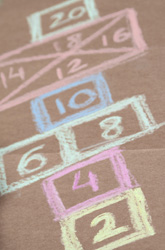
Using chalk, draw a series of six connecting hopscotch boxes on the sidewalk or on a driveway. In the first four boxes, write a series of four numbers showing a pattern of counting by 2s. (For example, 2,4,6,8). Write one number in each box.

Have your child extend the pattern by filling in the empty boxes with numbers that extend this sequence. To demonstrate the pattern, ask your child to hop on each of the boxes in the series, saying each number aloud.

This time, ask your child to draw two more sets of six to eight boxes. Fill in each set of boxes with a series of four numbers that show a pattern, such as counting by 5s, counting by 10s, decreasing by 1s, or decreasing by 2s. Do you have a math whiz? You can also experiment with counting by 3, 4, or 6…this lays the foundation for multiplication.

Although the boxes may look non-traditional, the game of hopscotch is still timelessly fun. Make your boxes…and then hop on. In teacher terms, you’re doing “kinesthetic” learning—using the body to integrate key intellectual skills and knowledge. In kid terms, you’ll be having tons of fun!
Sponge Relay

Sponge Relay

Sponge Relay
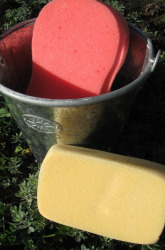
Looking for a way to cool off on a hot day? Here’s a fun game to play! Make some trivia question cards, grab a sponge, a bucket of water, two containers, and a few kids and you can have yourselves a sponge race. Two teams will compete against each other, testing their knowledge as they try to fill up a bucket of water by squeezing a sponge.

What You Need:
Index cards
Pencil or pen
2 sponges
2 buckets of water
2 medium size plastic containers (called knowledge containers for the purpose of the game)
4 or more players
Sponge station monitor (teachers, parents and older kids make the best monitors)
What You Do:
Take the index cards and write age appropriate trivia questions on them. Simple math equations, geography questions, even questions about grammar and science can be included. Each question card should have a question on one side and a number on the other. Don’t repeat any of the assigned numbers.

For each question card, you’ll need to create a corresponding answer card numbered to match the question card.

Fill two buckets with water and drop a sponge into each.

Set up the empty plastic containers, called “knowledge containers,” one next to each bucket.

The bucket and knowledge containers will be supervised by a monitor. The monitor will give each player permission to squeeze the sponge to fill up the knowledge container.

Divide players into two teams.

Place the question quiz cards in a pile in between, and about 5 feet in front of the sponge stations.

Set up the answer quiz cards beyond the sponge station and have the answer facing down. Also, make sure all the numbers are visible.

Have the two teams line up about 20 feet away from the question cards.

Explain to the players that when it’s their turn, they should run to the stack of question cards and draw one.

After a player has drawn a card, he should continue on to the sponge station and tell the monitor the number on his card as well as his answer to the question.

The monitor should pick up the corresponding answer card and check to see if the answer is right.

If the player gets the answer right, he should submerge and squeeze the sponge so it can soak up water. Then, he should hold the liquid-heavy sponge over the knowledge container and squeeze to fill it with knowledge.

The player should then put the sponge back in the bucket and run back to tag the next player.

If the player doesn’t get it right, the monitor should give him one more opportunity to answer correctly.

If the second answer he gives is wrong, he should return to tag the next player.

The first team to fill up the knowledge container wins!

This is a great end-of-the-year activity as it’ll test the knowledge that your students have accumulated during the school year.

Tip: If you’re playing with a diverse group, you might want to have different question piles of varying levels of difficulty.


Homonym Beanbag Toss

Homonym Beanbag Toss

Homonym Beanbag Toss
As second graders get quicker and more accurate with the written word, you can expect them to spend plenty of time discovering and mastering homonyms. These are tricky little words that tend to confound early readers because they sound the same but are spelled differently. Hear and here, for example, are homonyms; so are their, they’re and there, and to, too, and two. Kids run into homonyms early on in their reading days, and they can be quite a challenge. First graders, for example, crave simple, predictable rules of phonics, and homonyms have a way of blasting them. But now, second graders are ready to have some fun exploring these classic quirks of our language.

Homonyms are often taught with worksheets in second grade, but with a little extra ingenuity, they can also lend themselves to marvelous physical games. Here’s one we recommend:

What You Need:
Stretch of blank pavement
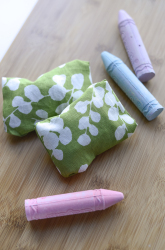
3-5 beanbags
Chalk
2 or more kids
What You Do:
Use your chalk to write several classic homonym words on a stretch of pavement. Place each word in a box of three different sizes—some boxes will be huge; others, medium sized; others, more difficult, will be small. You and your child can explore lots of different words, but you will want to be sure that by the end of second grade, your child will know too, to, and two; here and hear; see and sea; and their, they’re, and there. So start with those today!

Now measure a few yards back from the words and their boxes—you can adjust the distance, depending on your child’s aim—and take out the beanbags. Have kids take turns throwing; the object of the toss should be to cover all the boxes for one homonym. Let’s say, for example, that a child chooses to, two, and too. The aim should be to hit those three boxes accurately, and then tally the score. A small box counts three points; a medium one, two; and a large box counts one. Any complete match of two or three words forming a homonym gives a Grand Sweep Score of Ten!

Do pay attention to how close or far your child is standing. If the game is too hard, move the throw line forward; if it’s too easy, move it back. But do keep playing, and as your kids learn one set of homonyms, don’t hesitate to launch another. Just rinse off the chalk and start again!

What’s going on? In second grade, kids start to spend more time on desk work, and less in what learning experts call “kinesthetic,” or full-body learning. But “kinesthetic” work is still a powerful way to learn, and kids of all ages can thrive on it. So go ahead and toss away!