Pool Basketball

Pool Basketball

Pool Basketball
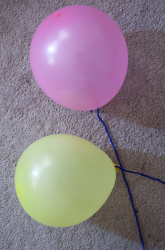
Summer is probably your child’s favorite time of year. And who could blame her? Being out of school leaves time for tons of warm weather activities, like swimming and basketball! But if you’ve ever had a hard time deciding which one to do, try this activity and get the best of both worlds! It’s simple: use a water balloon in place of a basketball, a hula hoop in place of a basketball hoop, and a water balloon as a ball. You’re ready for a fun and refreshing day in the sun! It’s a great game to play as a family and is perfect for all ages.

What You Need:
Water balloons (or a small beach ball)
2 hula hoops
Swimming pool
What You Do:
Set one hula hoop at each end of the pool. They’ll probably float around a bit, but that’s okay because it will make the game more challenging and exciting!

Use one balloon as the ball. Keep a few balloons in a bucket so you have an extra in case one pops.

Divide the players into two teams, and have each team face off between the hula hoops. Toss the water balloon into the middle of the pool and let the games begin!

Each team tries to score points by shooting the balloon into the hoop on the opposite end of the pool; every goal is worth one point.

The first team to reach ten points wins!

Pool Obstacle Course

Pool Obstacle Course

Pool Obstacle Course
What’s a fun way to challenge your kids to have fun and be fit? A pool obstacle course, of course! Here’s a guide to help you and your kids create an innovative course with ordinary pool toys and household objects. You can use just about anything to design your course, from hula hoops to beach balls to rafts. So get creative with your design and build an exciting course for all ages!

What You Need:
Hula hoops
Rafts
Pool noodles
Other pool items like baskets or buckets, water balloons, dive-and-relay sticks, beach balls, etc.
Stopwatch (optional)
What You Do:
Start by creating your obstacle course! Set up two identical obstacle courses in and around the pool. Leave enough room between the obstacles for children to navigate safely. (If the pool is not large enough for two courses, set up one course and have the kids time themselves instead.)

Be sure to vary the number and difficulty of the obstacles based on the ages and the skill levels of the swimmers.

Some examples of pool obstacles and activities are below:
Dive through, jump through, or swim up and through a hula hoop
Ride noodles or rafts from one point to another
Collect items like dive-and-relay sticks from the bottom of the pool
Throw beach balls into a bucket or basket from a distance
Try to hit a target with water balloons
Swim in a particular style (i.e. front stroke, breast stroke, back stroke, doggie paddle) from one point to another
Toss rings onto a noodle
Perform a cannonball

Now play the game. Divide the players into two teams. If there was no room for two courses, use a stopwatch to time each team individually.

Have each player take a turn navigating the obstacle course. The next player in the team can start the course only when the one before him is finished with it.

The team whose players finish the obstacle course first—or in the shortest time—is the winner!
Variation: The leader can have children play this game individually as well. In this case, time each player as he travels through the obstacle course. A player can go multiple times with the goal being to improve upon his own best time.

Chain Tag

Chain Tag

Chain Tag
Check out this fun pool game that will keep the kids occupied on those hot days at the pool. Not only does it encourage group communication, it’ll also encourage teamwork and help them develop important communication skills. This unique group game is sure to be a hit and will get everyone laughing this summer.

What You Need:
2 floating pool ropes
As many friends as you can get
Pool
What You Do:
Have your child and her friends section off a portion of the middle of the pool using the floating pool ropes (alternatively, they could improvise markers on the ground outside the pool).

Then, have your child and her friends decide who will be “it.”

The child that is “it” must tread water in the center of the sectioned off portion of the pool.

Next, have the remaining children line themselves around the perimeter of the sectioned off portion of the pool.

When you call go, the child that is “it” must swim around, trying to tag as many people as possible.

Every person that the child who’s “it” tags must link arms with him or her and form a chain.

The “it” chain must then work together to tag other players.

The last person to be tagged is the winner of the game.

For the next round, the child that was first tagged to become part of the “it” chain must start off as the player who’s “it.”
Have fun playing chain tag!

Play Pattern Hopscotch!

Play Pattern Hopscotch!

Play Pattern Hopscotch!
Creating number patterns with pencil and paper can be dull. But creating patterns with hopscotch? Way cool! Get your child’s game on, and give her some math practice in the process. While developing pattern skills, students build a firm foundation for algebraic thinking. Here’s a fun at-home activity that will have your child recognizing, describing, and extending patterns using hopscotch squares.

What You Need:
Chalk
Sidewalk or driveway
Stone
What You Do:
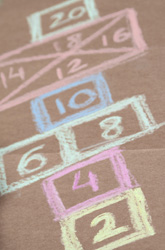
Using chalk, draw a series of six connecting hopscotch boxes on the sidewalk or on a driveway. In the first four boxes, write a series of four numbers showing a pattern of counting by 2s. (For example, 2,4,6,8). Write one number in each box.

Have your child extend the pattern by filling in the empty boxes with numbers that extend this sequence. To demonstrate the pattern, ask your child to hop on each of the boxes in the series, saying each number aloud.

This time, ask your child to draw two more sets of six to eight boxes. Fill in each set of boxes with a series of four numbers that show a pattern, such as counting by 5s, counting by 10s, decreasing by 1s, or decreasing by 2s. Do you have a math whiz? You can also experiment with counting by 3, 4, or 6…this lays the foundation for multiplication.

Although the boxes may look non-traditional, the game of hopscotch is still timelessly fun. Make your boxes…and then hop on. In teacher terms, you’re doing “kinesthetic” learning—using the body to integrate key intellectual skills and knowledge. In kid terms, you’ll be having tons of fun!

Sponge Relay

Sponge Relay

Sponge Relay
Looking for a way to cool off on a hot day? Here’s a fun game to play! Make some trivia question cards, grab a sponge, a bucket of water, two containers, and a few kids and you can have yourselves a sponge race. Two teams will compete against each other, testing their knowledge as they try to fill up a bucket of water by squeezing a sponge.

What You Need:
Index cards
Pencil or pen
2 sponges
2 buckets of water
2 medium size plastic containers (called knowledge containers for the purpose of the game)
4 or more players
Sponge station monitor (teachers, parents and older kids make the best monitors)
What You Do:
Take the index cards and write age appropriate trivia questions on them. Simple math equations, geography questions, even questions about grammar and science can be included. Each question card should have a question on one side and a number on the other. Don’t repeat any of the assigned numbers.

For each question card, you’ll need to create a corresponding answer card numbered to match the question card.

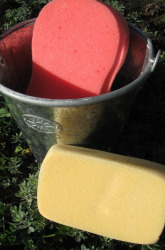
Fill two buckets with water and drop a sponge into each.

Set up the empty plastic containers, called “knowledge containers,” one next to each bucket.

The bucket and knowledge containers will be supervised by a monitor. The monitor will give each player permission to squeeze the sponge to fill up the knowledge container.

Divide players into two teams.

Place the question quiz cards in a pile in between, and about 5 feet in front of the sponge stations.

Set up the answer quiz cards beyond the sponge station and have the answer facing down. Also, make sure all the numbers are visible.

Have the two teams line up about 20 feet away from the question cards.

Explain to the players that when it’s their turn, they should run to the stack of question cards and draw one.

After a player has drawn a card, he should continue on to the sponge station and tell the monitor the number on his card as well as his answer to the question.

The monitor should pick up the corresponding answer card and check to see if the answer is right.

If the player gets the answer right, he should submerge and squeeze the sponge so it can soak up water. Then, he should hold the liquid-heavy sponge over the knowledge container and squeeze to fill it with knowledge.

The player should then put the sponge back in the bucket and run back to tag the next player.

If the player doesn’t get it right, the monitor should give him one more opportunity to answer correctly.

If the second answer he gives is wrong, he should return to tag the next player.

The first team to fill up the knowledge container wins!

This is a great end-of-the-year activity as it’ll test the knowledge that your students have accumulated during the school year.

Tip: If you’re playing with a diverse group, you might want to have different question piles of varying levels of difficulty.
 

Homonym Beanbag Toss

Homonym Beanbag Toss

Homonym Beanbag Toss
As second graders get quicker and more accurate with the written word, you can expect them to spend plenty of time discovering and mastering homonyms. These are tricky little words that tend to confound early readers because they sound the same but are spelled differently. Hear and here, for example, are homonyms; so are their, they’re and there, and to, too, and two. Kids run into homonyms early on in their reading days, and they can be quite a challenge. First graders, for example, crave simple, predictable rules of phonics, and homonyms have a way of blasting them. But now, second graders are ready to have some fun exploring these classic quirks of our language.

Homonyms are often taught with worksheets in second grade, but with a little extra ingenuity, they can also lend themselves to marvelous physical games. Here’s one we recommend:

What You Need:
Stretch of blank pavement
3-5 beanbags
Chalk
2 or more kids
What You Do:
Use your chalk to write several classic homonym words on a stretch of pavement. Place each word in a box of three different sizes—some boxes will be huge; others, medium sized; others, more difficult, will be small. You and your child can explore lots of different words, but you will want to be sure that by the end of second grade, your child will know too, to, and two; here and hear; see and sea; and their, they’re, and there. So start with those today!

Now measure a few yards back from the words and their boxes—you can adjust the distance, depending on your child’s aim—and take out the beanbags. Have kids take turns throwing; the object of the toss should be to cover all the boxes for one homonym. Let’s say, for example, that a child chooses to, two, and too. The aim should be to hit those three boxes accurately, and then tally the score. A small box counts three points; a medium one, two; and a large box counts one. Any complete match of two or three words forming a homonym gives a Grand Sweep Score of Ten!

Do pay attention to how close or far your child is standing. If the game is too hard, move the throw line forward; if it’s too easy, move it back. But do keep playing, and as your kids learn one set of homonyms, don’t hesitate to launch another. Just rinse off the chalk and start again!

What’s going on? In second grade, kids start to spend more time on desk work, and less in what learning experts call “kinesthetic,” or full-body learning. But “kinesthetic” work is still a powerful way to learn, and kids of all ages can thrive on it. So go ahead and toss away!

Pop the Balloons!

Pop the Balloons!

Pop the Balloons!
Popping a balloon is burst of fun with this balloon popping party game. This can be played either indoors or outdoors and is a great way to promote movement and makes exercise exciting. Whether you play inside or outside this game is sure to be a hit!

What You Need:
Balloons of several different colors
Scissors
String
What You Do:
Assign each player a different balloon color. Or, if you’re playing with a large group of kids, create color teams.

Have your child and his friends blow up and tie off at least 5 balloon of each color. The number of balloons you inflate should vary depending on how many kids are playing.

Encourage your child and the other players to scatter the balloons around the room or in the general area of play.
Have the players gather in the center of play.

When you shout, “Go!” the players try to pop as many of balloons of their color as they can by stomping on them.

Helpful Tip: If you decide to play outside, make sure that it isn’t too windy. You don’t want all of your balloons to blow away.

If you’re only playing with one kid, have him race against the clock to pop all of the balloons. Or, you coukd challenge him to pop them in a set order.


Play Drop Catch

Play Drop Catch

Play Drop Catch
Develop your child’s hand-eye coordination in an engaging way by challenging her to a game of Drop Catch. You can play this game with just a parent and child, or gather a couple of antsy kids, form a circle, and go at it as a group. Not only is this game rambunctious fun, but it works gross motor skills and big muscles– all too rare with today’s kids.

What You Need:
Ball
2 kids
What You Do:
Have the players stand at a distance from each other. They can be close together or far apart, whichever is most comfortable for them.
Instruct the players to throw the ball back and forth between them.
If a player drops the ball, he has to pay a penalty. On the first drop, he must go down on one knee and throw the ball back. If he catches the ball on the next throw, he can stand up again. If not, he goes down on both knees. Here are all the penalties according to number of drops:
1st drop: go down on one knee

2nd drop: go down on both knees

3rd drop: go down on both knees, one hand on the ground

4th drop: go down on both knees, one hand on the ground, one eye closed

5th drop: go down on both knees, one hand on the ground, both eyes closed

6th drop: you’re out

For each ball caught, a player can only subtract one penalty level. For example, if a player is at the 4th penalty level, with both knees on the ground, one hand on the ground, and one eye closed, and catches the ball, he can move up to the 3rd penalty level. If he catches the ball again, he moves to the 2nd penalty level, and so on.
Encourage the players to keep tossing the ball until one person is out.

Olympic Games for Kids

Olympic Games for Kids

Olympic Games for Kids
In first grade, students are developing their graphing skills. They’re learning how to record, organize, and show data. Of course, all of that can get a little dry. To spice it up, form your own Olympics committee and host The Olympic Games for Kids, right in your own backyard! Appoint your child statistician, and collecting data and showing the results on a graph will be serious fun. Let the games begin!

What You Need:
Ball suitable for kicking
Yard or play area
Measuring tool (yardstick, tape measure)
String or rope for a starting line
Paper
Ruler
Markers or crayons (at least 5 different colors)
Pencil
What You Do:
Set up a “Kick Ball” venue. Decide where to position the “kicking lane” and use a length of string to mark the starting line. Give each child five opportunities to kick the ball. After each kick, measure the distance and record it.

Set up a bar graph. This will help your child show and compare her results. On the x-axis (the horizontal line) label the number of each kick, using ordinal numbers (1st, 2nd, etc.) On the y-axis (the vertical line) show the number of feet. Begin with 0 feet and then continue the numbers until you reach the number that is a few feet farther than your child’s farthest kick. You can show the numbers in increments of 2, 5, or 10. To create a grid, draw a horizontal line to the right of each number showing feet. Draw intersecting vertical lines to the right of each labeled kick (1st, 2nd, etc.).

Record results. Show your child how to make bars on the graph showing the distance for each kick. Let your child color the boxes of each bar.

Talk about the meaning of the graph. Compare the results with your child. Ask questions like, “Which kick shows the greatest distance? How do we know it from the graph?” (It shows the longest row). Ask which row shows the shortest kick, and how we can see that on a graph as well. Finally, show your child your preliminary recording of his kicking distances and and ask him to compare this with the bar graph you’ve made. Ask him which method of showing data is easier for him to understand. After you’re discussion is finished, be sure to congratulate your child on his success in Backyard Olympics!

Once your child gets the hang of graphs, you’re ready to add more events to your Olympic games! Long jumps work well; so does swinging on monkey bars (How many bars can you reach in thirty seconds? One minute?); or jumping rope. Whatever you choose, keep a record and talk it over. You’re helping your child build crucial intellectual skills while using the power of his entire body.

Play Four Square!

Play Four Square!

Play Four Square!
What kid doesn’t enjoy bouncing a ball around? Similar to the playground game Four Square, this group game helps your child improve his hand-eye coordination and boosts important social skills like group cooperation, teamwork, group problem solving, and compromise. You can play Bounce in the Square on any flat, paved surface with just a bit of sidewalk chalk, a bouncy ball, and at least 4 enthusiastic players. Preparation takes less than two minutes, and the fun lasts all day!

What You Need:
4 or more players
Playground-style rubber ball
Sidewalk chalk
Flat paved surface at least 8′ X 8′ large (like a driveway or patio)
What You Do:
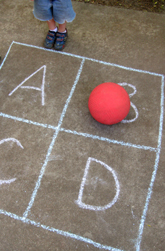
To create your playing court, draw a 2 x 2 square grid measuring 8′ x 8′ on the paved surface with the sidewalk chalk. Draw a large capital “A” in the upper left square, a capital “B” in the upper right square, a capital “C” in the lower right square, and a capital “D” in the lower left square.
The player in square A gets the ball first. Each of the squares is ranked, with A being the highest and D being the lowest. The goal of the game is to get to square A and remain there for as long as possible.
To begin the game, player A bounces the ball in his square, then serves it to a player in another square by either hitting it lightly with the palm of his hand or gently tossing it.
Each time the ball bounces in a player’s square, he must hit or catch and toss the ball into another square, making sure the ball bounces only once in his square. If a player catches the ball before it falls in his square, he must bounce it in his square before returning it.
Have the players continue hitting and tossing the ball back and forth until one of the players fails to return the ball to an opponent. That player then moves to square D and the players who were behind him move up one square. For example, if player B fails to return the ball, he moves to square D and players C and D move to squares B and C, respectively.
If more than 4 children are playing, have those who don’t have a square form a line next to the court. When a player fails to return a ball, he moves to the back of the line and the player at the start of the line moves to square D.
To make the game more challenging, incorporate special calls into the play. A special call is a spontaneous action prompt given by player A that all players must follow. Player A must have the ball before making a special call. If a player fails to execute a special call, he moves to square D or to the back of the line. Examples of special calls:
Corners: All players run to the farthest corner of their squares.
Bus Stop: All players run to cover their letter with one foot.
Candlesticks: Player A starts by throwing the ball into the air, claps once, then catches the ball and passes it to player B. Player B then does the same, except he must clap twice instead of once! The action continues around the squares, each subsequent player adding an extra clap.
Taxi: All players run to cover their letter with two feet.
Titanic: All players kneel on one knee, mimicking the motion of a sinking ship.